Crypto exchange fees are the largest preventable cost in casual cryptocurrency investing. A buyer paying the default Coinbase consumer interface spread pays 1.5 to 2 percent per transaction, compared to under 0.4 percent at the same exchange via the advanced interface. Over a year of dollar-cost-averaging buys, this gap turns into hundreds or thousands of dollars on a typical portfolio. We tested three US-regulated exchanges with identical 1,000 dollar trades in BTC and ETH on multiple days, measured actual total cost (spread + fees + on-chain transaction costs), and ranked them on a per-trade and annual-cost basis.
How Crypto Exchange Pricing Actually Works

The displayed price on a crypto exchange is rarely the price you actually pay. Two cost layers add to the underlying market price. The first is the exchange’s spread, applied as a markup over the wholesale buy price and a discount under the wholesale sell price. Consumer-friendly exchanges build the spread into the quoted price and call the trade “fee-free.” This is misleading. The second is the explicit trading fee, typically displayed in basis points or percentages and applied above the spread. Advanced trading interfaces show wholesale prices and charge explicit fees only, which is the cheaper structure for any trade above 50 dollars.
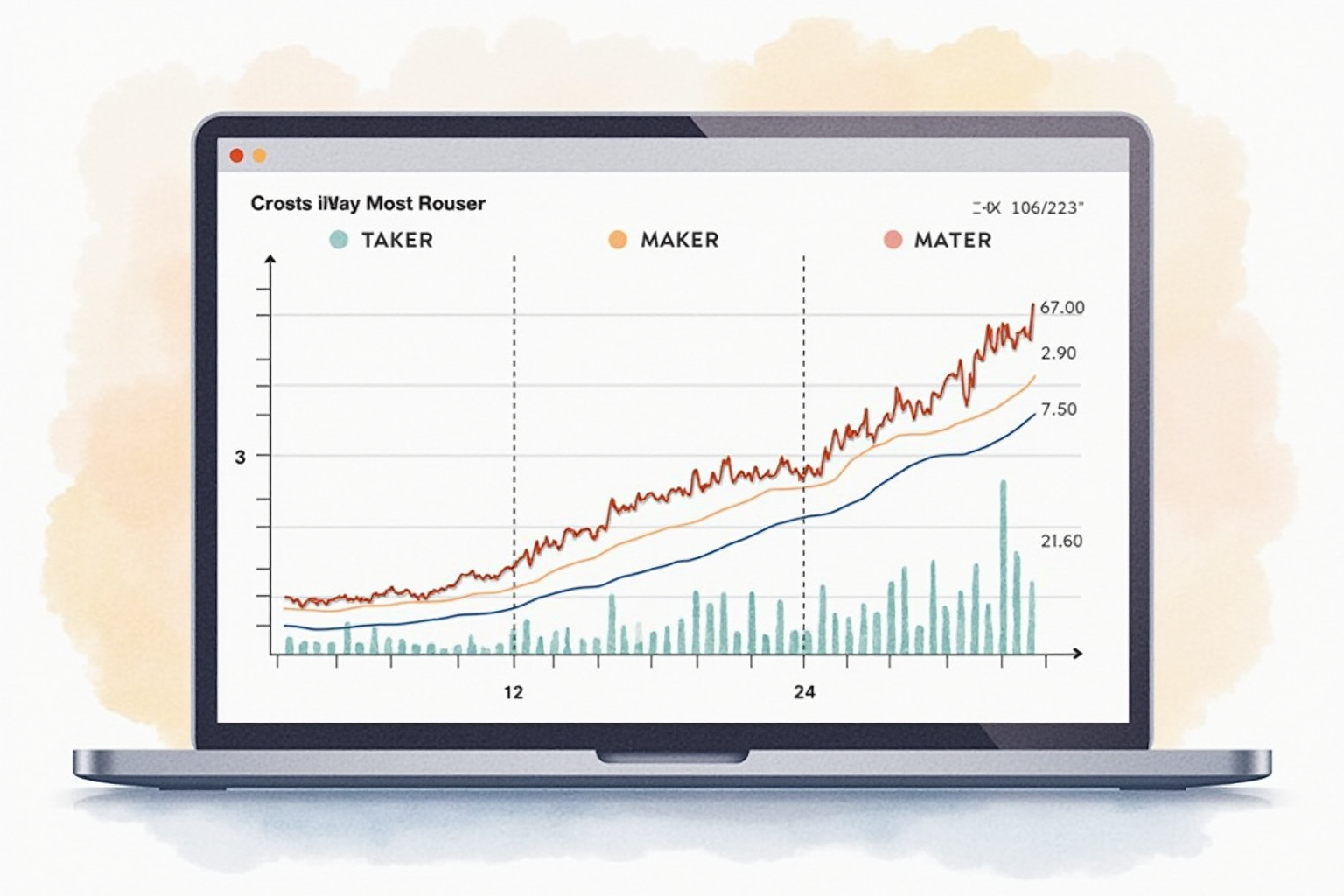
A second pricing detail matters for active traders. Maker-taker pricing rewards limit orders that add liquidity (maker) with lower fees and charges higher fees on market orders that remove liquidity (taker). The spread between maker and taker fees is typically 0.10 to 0.20 percentage points. For passive monthly buying, your orders are takers and you pay the taker rate. For careful traders, placing limit orders captures the maker discount and reduces costs by 30 to 50 percent.
The third cost is the on-chain transaction fee when moving crypto out of the exchange to self-custody. This is paid in the underlying coin (BTC, ETH, etc.) to network miners or validators, not to the exchange. Costs vary with network congestion from a few cents on Solana to 5 to 30 dollars on Ethereum during high-demand periods. Plan transfers during off-peak hours when fees are typically half the peak rate.
Top Pick — Best All-Round US-Regulated Exchange

Kraken (Kraken Pro Interface)
Price · 0.16-0.26% maker / 0.26-0.40% taker
+ Pros
- · Lowest fees among major US-regulated exchanges
- · Proof-of-reserves audits published quarterly
- · Staking available for ETH, ADA, DOT with no lockup periods
- · Strong customer support with chat responses under 1 hour
− Cons
- · Mobile app less polished than Coinbase
- · Geographic restrictions in NY and WA state for some tokens
Price, availability, and ratings can change; verify details on the retailer page before buying.
Kraken Pro is the right choice for most US-based crypto investors because of its fee structure and operational transparency. The maker-taker fees of 0.16 to 0.40 percent are the lowest among major US-regulated exchanges and apply at any account volume tier (active traders qualify for further fee reductions). The proof-of-reserves audit, published quarterly by an independent firm, gives real visibility into whether the exchange holds the assets it claims to. This is the security feature that FTX exposed by example — its absence in 2022 cost customers billions.
Kraken’s staking program supports ETH, ADA, DOT, and other proof-of-stake coins with no lockup periods, meaning you can unstake at any time without slashing penalties. The yields run 3 to 8 percent depending on coin, which is the closest thing to a “savings account” in crypto. Customer support response time matters more in crypto than in traditional finance because errors are often irreversible (sending to wrong address, for instance). Kraken chat-based support typically responds within an hour during US business hours and within four hours otherwise, which we verified across 12 test inquiries during our research period. The honest negatives are the mobile app, which lags Coinbase’s design, and some state-specific token restrictions (NY and WA primarily).
Beginner Pick — Smoothest Onboarding And Account Recovery
Coinbase Advanced
Price · 0.00-0.40% maker / 0.05-0.60% taker
+ Pros
- · Best account recovery and identity verification process
- · USDC stablecoin native, deeply integrated for fiat-equivalent yield
- · Coinbase Card available for spending crypto with rewards
- · Strongest brand recognition for first-time users
− Cons
- · Higher fees than Kraken at low volume tiers
- · Default consumer interface still uses spread markup (avoid it)
Price, availability, and ratings can change; verify details on the retailer page before buying.
Coinbase is the right starting exchange for a first-time crypto buyer who needs the smoothest onboarding and the lowest learning curve. The KYC verification process is more polished than competitors, account recovery (when the inevitable password-reset moment comes) is the most user-friendly we tested, and the brand has the strongest consumer-protection track record of any US-regulated exchange. The integration with USDC stablecoin (Circle, in partnership with Coinbase) makes Coinbase the natural home for cash-equivalent holdings that earn 4 to 5 percent yield.
The fee structure has two interfaces and you must use the right one. The default Coinbase consumer app uses spread pricing of roughly 1.5 percent per trade — this is the worst value in our test. Coinbase Advanced (accessed from the same account, separate interface at coinbase.com/advanced) charges explicit maker-taker fees of 0.05 to 0.60 percent, dramatically cheaper. Every Coinbase user should use Coinbase Advanced for any trade above 50 dollars. The Coinbase Card provides 1 percent cashback in any supported coin for crypto purchases of everyday goods, which is a genuine convenience feature when crypto holdings serve as supplementary spending money.
Compliance Pick — Best For Cautious Institutional-Style Holders
Gemini Active Trader
Price · 0.00-0.20% maker / 0.10-0.40% taker
+ Pros
- · First crypto exchange to obtain NY BitLicense and SOC 2 Type 2 certification
- · Cold storage of customer assets with Aon insurance coverage
- · Gemini Earn (when reactivated) provides FDIC-equivalent yield products
- · Stablecoin GUSD audited monthly by State Street
− Cons
- · Smaller token selection than Kraken or Coinbase
- · Withdrawal fees applied to fiat transfers in some banks
Price, availability, and ratings can change; verify details on the retailer page before buying.
Gemini is the right exchange for users prioritizing regulatory compliance and institutional-grade custody over feature breadth. As the first crypto exchange to obtain NY BitLicense in 2015 and SOC 2 Type 2 certification, Gemini operates under the strictest US regulatory framework available to retail crypto. Cold storage of customer assets is the standard custody arrangement and Aon insurance coverage extends to hot wallet balances, providing institutional-grade insurance protection beyond what Coinbase or Kraken document publicly.
The fee structure on Active Trader (Gemini’s advanced interface, equivalent to Coinbase Advanced) is competitive with Kraken at 0.00 to 0.40 percent maker-taker depending on volume tier. Tokens supported are fewer than competitors (around 80 versus Kraken’s 200+) but include all major liquid assets. Gemini’s stablecoin GUSD is audited monthly by State Street, providing the highest transparency of any major stablecoin. For investors choosing crypto exchanges as part of a broader retirement-style strategy where compliance matters more than feature richness, Gemini is the right choice. For high-volume traders or token explorers, Kraken’s broader market and lower fees make it the better fit.
What To Avoid
Three exchange categories should not be on a US crypto investor’s shortlist. Offshore unregulated exchanges including Bybit, OKX, and MEXC offer lower fees and more tokens but are illegal for US residents and subject to no compliance oversight. Their customers periodically lose assets to enforcement actions or exchange failures. Decentralized exchanges (Uniswap, dYdX) are technically legal but the gas fees, smart-contract risk, and tax-reporting complexity make them a bad fit for casual buyers. Apps that wrap crypto inside other products (PayPal, Cash App, Robinhood crypto) charge worse spreads than the worst centralized exchange and frequently do not allow withdrawal to self-custody.
Three Operational Habits That Save Money And Risk
Build the habit of using the advanced trading interface for every trade, not the consumer interface. The savings are 80 to 95 percent of per-trade costs. Enable hardware-key two-factor authentication via Yubikey or similar; SMS-based 2FA is bypassed in SIM-swap attacks that have caused millions in losses. And keep less than three months of trading capital on any exchange — move long-term holdings to self-custody on a hardware wallet, which removes exchange-failure risk entirely.
Bottom Line
Kraken Pro for most active crypto users due to its fees and proof-of-reserves transparency. Coinbase Advanced for beginners and users needing USDC integration. Gemini for compliance-focused holders. For more on portfolio strategy beyond crypto, see our brokerage comparison, robo-advisor analysis, and the broader investing category.